Make the background disappear.
Everything that raises the sky background is your enemy: moonlight, high cloud, haze and twilight. Seeing matters far less than observers expect.
Try the same galaxy under four skies.
Darkness, transparency and moonlight control contrast. Move seeing last and notice how little the verdict changes.
Go faint.
The sky background stays dark enough for low-surface-brightness structure.
Why background wins
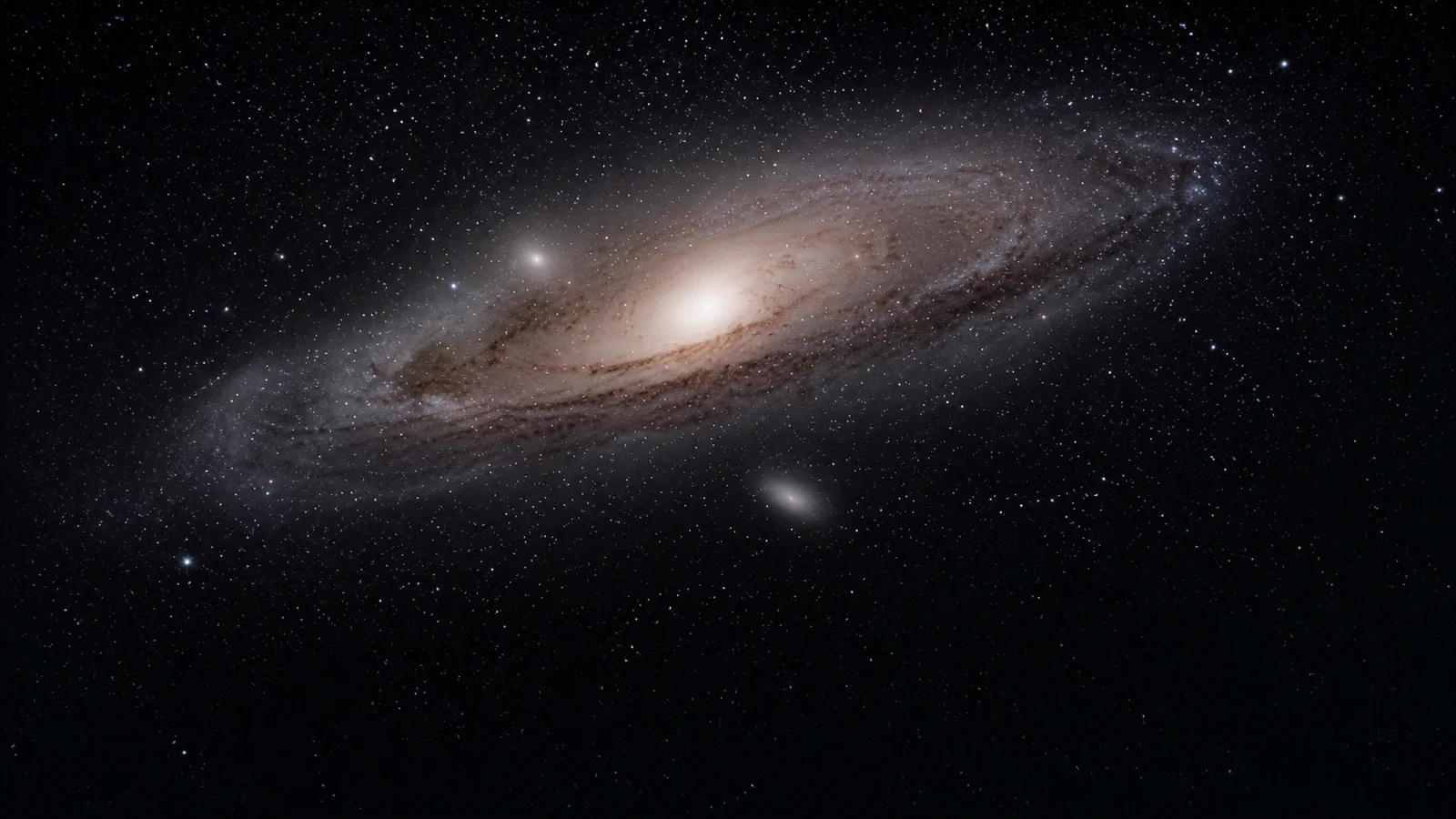
Faint extended objects are a contrast problem, not a resolution problem. A galaxy is a low-surface-brightness smudge and you detect it only by how far it sits above the background. Anything that lifts the background — the moon, scattered light from cirrus, residual twilight, light pollution — eats directly into the thing you are trying to see.
Seeing is comparatively unimportant. Soft, wobbly air spreads a star into a fatter disc, but a galaxy is already a diffuse patch and slightly softer optics change very little about whether you can detect it. Plenty of memorable deep-sky nights happen under mediocre seeing.
Why the target mode differs
This is the exact inverse of the planetary case, and it is why the two share a forecast but not a verdict. The deep-sky mode weights moonlight and darkness heavily, transparency strongly, and seeing only lightly.
Aperture and sky quality both help, but sky quality is the one you can change tonight by driving. The usual shorthand for it is the Bortle dark-sky scale, a nine-level classification John Bortle published in Sky & Telescope in February 2001, running from Class 1 for the darkest skies on Earth to Class 9 for inner cities. It is a descriptive scale and it correlates only loosely with naked-eye limiting magnitude, which depends heavily on the individual observer.
When driving darker pays
For a measured figure rather than a described one, DarkSky International certifies parks using sky quality meter readings in magnitudes per square arcsecond: gold tier above 21.75, silver 21.0 to 21.74, bronze 20.0 to 20.99.
That trade — the gain from driving somewhere darker, against the cost of the drive — is what the site comparison tool exists to settle.